
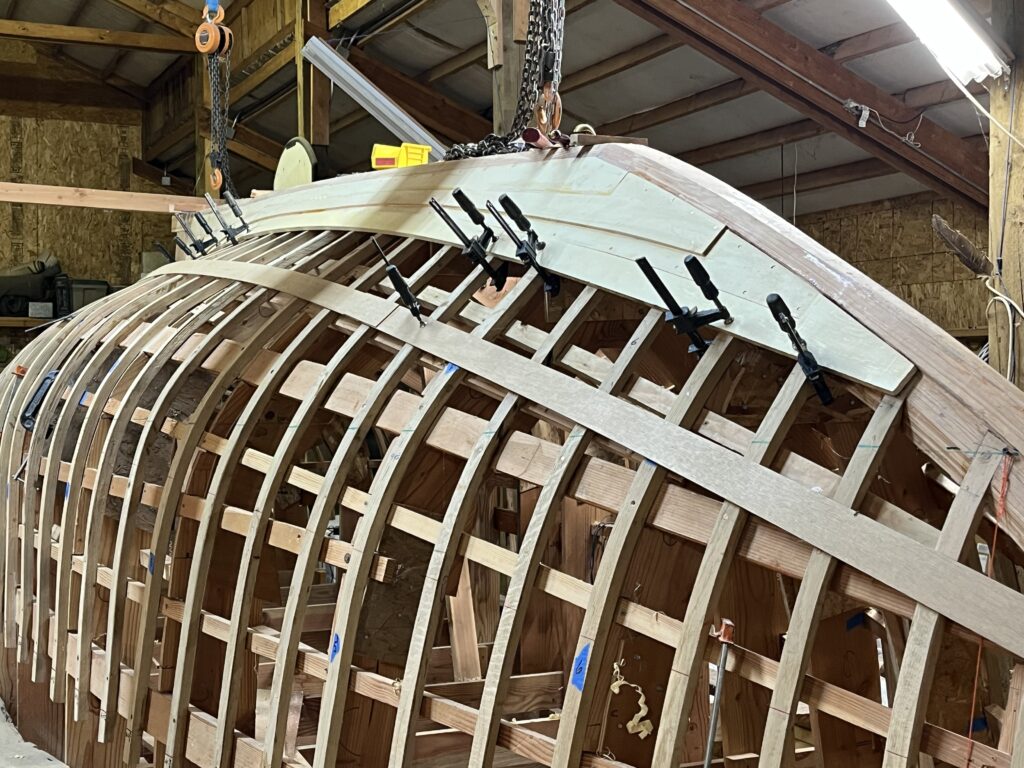
While lining out may just seem like common sense (as someone commented) doing it on a pointy end like this made me scratch my head. Nothing is common sense until you’ve done it a few times. In the end, after several false starts, I divided the mid-section into 3 areas based on hull radius and then figured number of planks and width for each. Then I just ran out the battens at the ends by eye. This method ensures that the ones in each of the three sections will be the same along any frame, tapering evenly toward the ends. There are actually five sections, not three. Two of the five are what I guess you could call them, transition areas. As it turned out the topsides section, from the sheer to the turn of the bilge, needs five planks, from there to the tuck line (closer to the keel) I need nine planks. Then three broads and then the garboards, which are on already. This sounds really simple. I can’t say why it took 2 weeks to figure it out since I knew how to do it before I started. I can only say that before I had never done this and now, I’ve done it five times. You do get to a point where it is just common sense.
 I wanted to avoid cutting up a lot of stock to make battens, so I used tape which was inaccurate and came off. I used my laser, worthless. I made a plank scale which sort of worked but not accurate. I crawled over the entire boat with a 28-foot-long batten making marks which I later sanded off. My comfortable chair got a lot of use. I decided I’d go back to Larry Pardee’s book “The Hull”. Larry had a method to avoid backing out, the hollowing out of the backs of planks to fit the curve of frames. I made a gauge in inches and eights and ran it up each frame to figure the maximum width of a plank along each frame that would allow for no backing out. The goal being that no plank along this frame could be wider than the minimum width determined by this gauge. This was useful but it must be done in each of my three sections. Larry reasoned that backing out is inefficient and avoidable. He’s right and I agree but there is a big difference between his build of Tallisen, a 28 foot Bristol Chanel Cutter and my Theresa. Larry had an almost inexhaustible supply of teak he had harvested in Samoa. I, on the other hand am counting millimeters. And so, I wondered in my midnight dreams whether it was more efficient to use wider but thicker planks and do the backing out, or use narrower, thinner planks and forget backing out. I opted for the former because of the width of my stock. Narrower planks would create too much waste. Every plank will need to be backed out to some extent. Learn to love it.
Now this all seems very simple, I tried every method that didn’t work, the psychosis of the last two weeks didn’t happen, the sun is shining. Three steps forward and two steps back. Time to get on with it. The topside planks will look great, all even and tapering gracefully toward the ends. Dockside lookers will stare in awe. Below the waterline they will vary slightly. If anyone is able to notice this, under water and through paint, they have better eyeballs than me.
Dave Ahrens