
In Texas there is a saying that “You can tell a man’s character by the shape of his woodpile.” I don’t know where this originated but I suspect it came from my grandfather. I heard it periodically as a child whenever my character was found to be needing adjustment. “Bark up!” I can recall him saying as I unloaded firewood from the back of a truck. “All your BTUs will fly out of there before you have a chance to burn it.” Today I spent most of the morning building character, lengthening my woodpile by about 12 feet. I now have 2 double rows 4 feet high and about 40 feet long. That’s enough for about 3 years. I would rather have done something else with my time like go stare at a boat for a while but as Hank Hill famously said (King of the Hill), “In Texas, what it means to be a man is you do things you don’t want to do.” Yes, I know, I’m no longer in Texas. Texas is a state of mind.
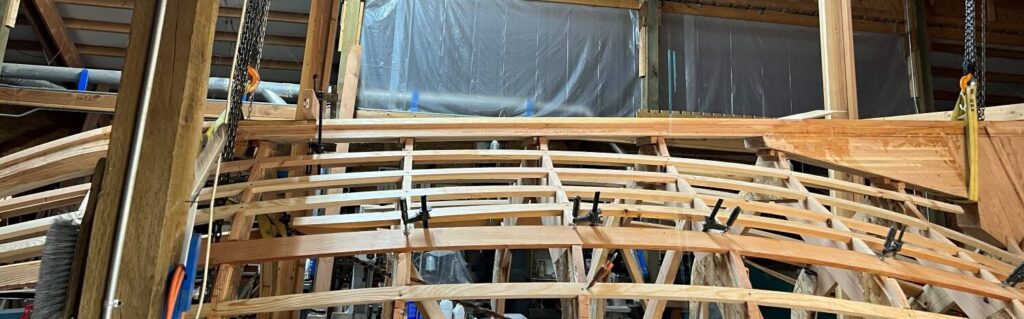
And speaking of Theresa, lately there has been the sweet smell of Alaskan Yellow Cedar in the shop. In August I went to Oregon to help my son build his house and on the way back, picked up 600 board feet of cedar for planking. I have just gotten around to doing something with it. It is random lengths up to 16 feet long, clear and mostly vertical grain. It has a very unusual smell when cut, almost like celery, very aromatic, unlike anything I have worked with before. I had thought of using Western Red Cedar but It was fortunately unavailable. I say fortunately because I have cut so much of it in the past that I have become sensitive to it. It is one of those woods. AYC is slightly stronger and denser and just as rot resistant. I returned home ready to start planking but as usual, having been gone for three weeks, there was much to do. There is just no end to the amount of stuff that will get in the way of building a boat. The first step I took toward planking is called lining out or lining off. It is a process of calculating and drawing out the number and widths of planks that will cover the framing from the rabbet (planking notch) to the sheer. Theresa has quite a shapely figure. She has not only what is called a wine glass hull at mid sections but she has also a canoe counter stern. Her measurements go from a girth at station 7 (midships) at 72” (1.8m) to 0” at each end. Obviously, you can’t just divide 72 by 4 and have 19 planks 4-” wide throughout. They need to be tapered but not too tapered. There are a myriad things to consider when planking. Most importantly, the angle of the hull, where they lie, how they are to be bent and where they might land. Best, common practice to break the hull up into different sections and treat them somewhat different. Howard Chapelle’s, Boatbuilding (1941) and Robert Steward’s, Boatbuilding Manual (1987) are my main references here, not to slight many others. For example, the garboard (next to the keel) can be wider. The hull is flatter here and the plank can be wider to take up more space. It is under water where no one will see it but solid attachment to the centerline and frames here is very important. The broads (next to the garboard) can be less wide and begin to even out the distance in girth fore and aft. The turn of the bilge is where the planks will need to be less wide and backed out (hollowed) on the back side to fit the curve of the frames. Backing out will occur on most planks at one location or another. By the time I get to the topside section (next to the sheer) my goal is to have even withs of planks at each station while keeping the ends of planks no narrower than 2” to allow for two screws there. We’ll see how it goes. There is usually a sequence to this. Chapelle says start with the sheer and then the garboards and then the broads. I am choosing to start with the garboards as I think they are the hardest and I can cover a lot of real estate there. Next the sheer plank and then back to the broads. Then work up and down to close it in with the shutter plank. In the below picture you can see the long, wide batten I have laid along the frames. This is to draw a line called the normal line (Chapelle) or the magic line (Louis Sauzedde). I think they are the same thing. It’s just a line around the hull, the shortest distance, where a batten lays naturally without any lifting up or sagging or edge setting. If you took a globe of the Earth, you would have the same thing, called the great circle route. The shortest route from the Philippines to San Francisco is through Alaska. It’s the same with a boat. There is only one great circle route from anywhere. I found several great circle routes on Theresa, which was kind of a mystery. However, I figured if a plank lays easily here the ones above it and below it may also lay similarly, or not. The goal is to get them on with as little twisting and turning as possible. I am mainly using this line as a reference in marking the garboards and broads. Above it you can see the first two parts of the garboard already made and ready to be screwed down. The connecting ends will be scarfed and glued with epoxy not joined on the inside with butt blocks. Scarfes are just a tapered joint with a certain ratio, length to thickness. These are 8:1, which means that since this layer of planking is one-half inch (13MM) the length of scarf will be four inches. I have made several types of jigs for scarfing. Some for the table saw and some for my router and I can also use my band saw. It is just as fast and more enjoyable though to cut them by hand with my #5 Stanley plane. There are well over 100 scarfs to go on Theresa. Some of the planks are quite long so I will be glueing them in place. Since I’m working by myself that will be a trick. And yes, you may have picked up that this is the “first layer”. There is another layer to be put on top of this one. The finished hull thickness is ¾” (19mm). There is a long way to go but this is easier than was the framing. It’s going to be quite a challenge to finish the planking by next summer but that is my target. The shape of this hull continues to stun me with admiration. A more shapely hull I can’t imagine. If you took a pear and put a keel on it you would pretty much have Theresa’s hull. Probably no one has ever planked a pear, but it would be a great exercise. Hmm, If I had nothing else to do…
Dave Ahrens
Lorem ipsum dolor sit amet, consectetur adipiscing elit. Ut elit tellus, luctus nec ullamcorper mattis, pulvinar dapibus leo.